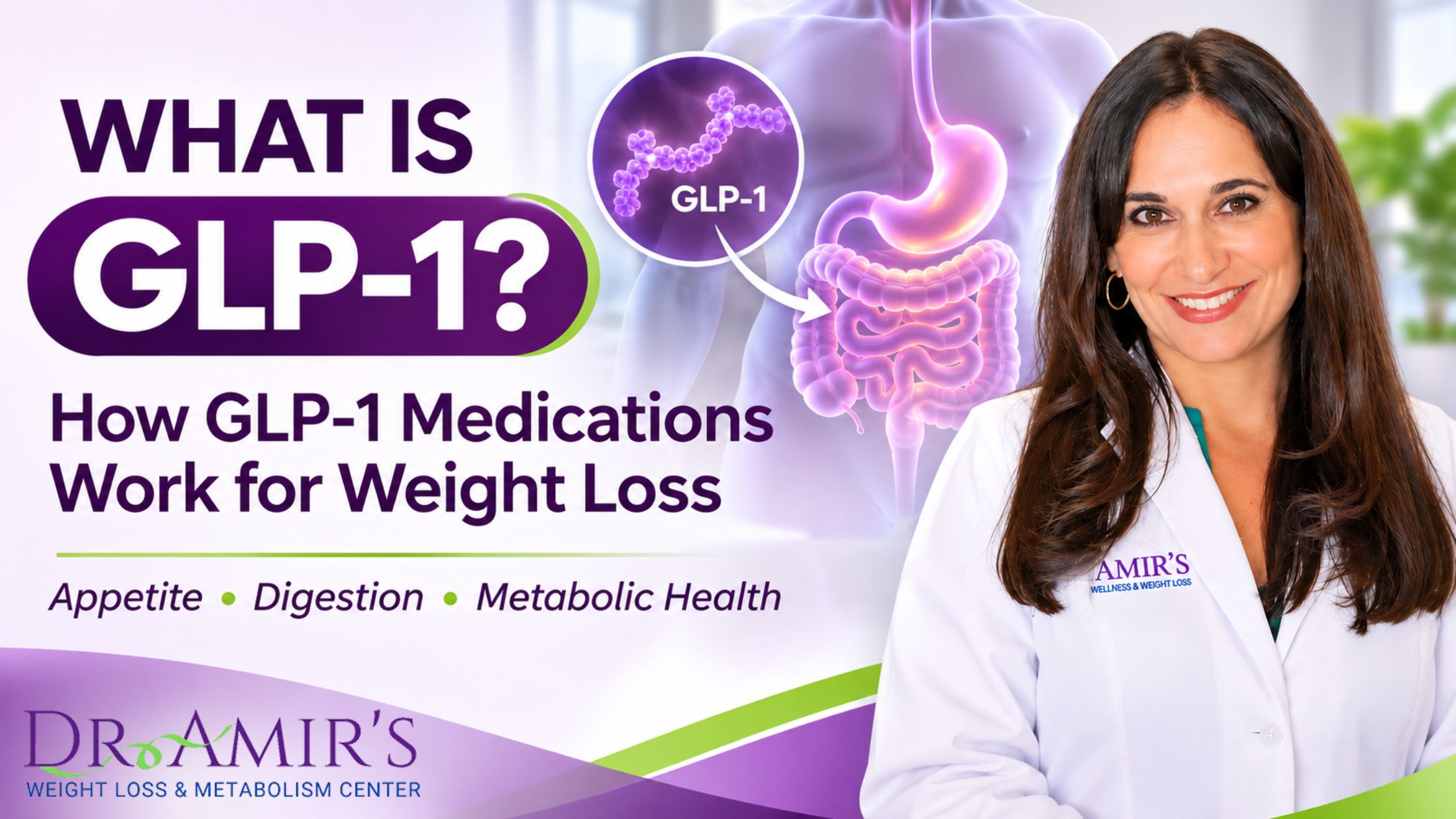
What Is GLP-1? How GLP-1 Medications Work for Weight Loss
GLP-1 has become one of the most discussed topics in medical weight management. From questions about GLP-1 weight-loss medications to searches for how these treatments work, many people want to understand the science behind this hormone and its role in appetite, metabolism, and body weight.
But what is GLP-1, and why is it important for people struggling with weight management?
GLP-1 stands for glucagon-like peptide-1. It is a naturally occurring hormone produced in the gut that helps regulate blood sugar, appetite, and digestion. Certain prescription medications work by mimicking the effects of this hormone, helping eligible patients manage appetite and support weight reduction as part of a comprehensive medical weight-management plan.
At Dr. Amir’s Weight Loss and Metabolism Center, weight management is approached through individualized medical evaluation, personalized nutrition and lifestyle guidance, and consideration of prescription treatments when clinically appropriate. Patients can also benefit from ongoing medical follow-up, telehealth services, and progress monitoring.
Understanding how GLP-1 works can help you make more informed decisions about your health and discuss appropriate treatment options with a qualified physician.
What Is GLP-1?
GLP-1, or glucagon-like peptide-1, is a hormone released by the digestive system, particularly after eating. It belongs to a group of hormones called incretins, which help the body regulate blood glucose levels.
GLP-1 plays several important roles in the body:
- Supports insulin release: It helps stimulate insulin production when blood glucose levels are elevated.
- Regulates glucagon: It helps reduce the release of glucagon, a hormone that signals the liver to release stored glucose.
- Slows stomach emptying: It can slow the movement of food from the stomach into the small intestine.
- Influences appetite: It helps signal fullness and plays a role in regulating food intake.
Together, these effects help explain why GLP-1 is important in both blood sugar regulation and appetite control.
GLP-1 medications are designed to activate similar biological pathways, although their effects and approved uses vary by medication.
How Does GLP-1 Work for Weight Loss?
One of the most common questions people ask is: How does GLP-1 help with weight loss?
GLP-1-based medications can influence several processes involved in appetite and food intake.
1. Helps Regulate Appetite
GLP-1 acts on pathways involved in appetite regulation. Medications that activate GLP-1 receptors can help some patients experience reduced hunger and greater feelings of fullness.
This may make it easier to follow a structured nutrition plan and manage overall food intake.
2. Promotes Feelings of Fullness
GLP-1 activity can influence how quickly the stomach empties and how full a person feels after eating.
Some patients may feel satisfied with smaller portions or experience fullness for longer periods. Individual responses vary.
3. Supports Blood Sugar Regulation
GLP-1 helps the body respond to elevated blood glucose by stimulating insulin release and reducing glucagon secretion.
This is one reason GLP-1-based medications have an established role in the treatment of certain metabolic conditions, including type 2 diabetes.
4. Supports a Comprehensive Weight-Management Plan
Although GLP-1 medications can help eligible patients lose weight, they are not a replacement for comprehensive medical care.
Nutrition, physical activity, behavioral changes, medical supervision, and long-term follow-up remain important parts of effective weight management.
What Are GLP-1 Medications?
GLP-1 medications are prescription treatments that activate the GLP-1 receptor and reproduce some of the effects of the body’s natural GLP-1 hormone.
Some medications in this category were initially developed to help manage type 2 diabetes. Certain formulations and medications are also approved for chronic weight management in eligible patients.
Examples include:
Semaglutide
Semaglutide is a medication that activates GLP-1 receptors. It is available under different brand names, including Ozempic, Wegovy, and Rybelsus. These products have different approved indications and should not be treated as interchangeable. Certain semaglutide products are approved for chronic weight management in eligible patients.
Liraglutide
Liraglutide is another GLP-1 receptor agonist. A specific formulation is approved for chronic weight management in eligible adults and certain adolescents.
Tirzepatide
Tirzepatide is commonly discussed alongside GLP-1 medications because it activates both GIP and GLP-1 receptors. It is therefore a dual-action incretin medication rather than a GLP-1-only medication. Certain formulations are approved for chronic weight management in eligible patients.
These medications are not interchangeable. They have different prescribing instructions, indications, dosing schedules, and safety considerations. The appropriate treatment depends on an individual’s health profile and medical evaluation.
Who May Be a Candidate for GLP-1 Weight-Loss Medication?
GLP-1 medications are not suitable for everyone. A physician must evaluate whether a particular treatment is appropriate based on medical history, current health, weight-related conditions, and individual treatment goals.
Depending on the medication and its approved indication, eligibility may involve factors such as:
- A diagnosis of obesity.
- Overweight accompanied by certain weight-related medical conditions.
- Type 2 diabetes or other relevant metabolic health considerations.
- Previous weight-management efforts and treatment response.
- Overall medical history and potential medication risks.
A medical consultation is important before starting treatment. A physician can review relevant health information, discuss potential benefits and risks, and determine whether medication should be part of an individualized weight-management plan.
What Are the Potential Benefits of GLP-1 Medications for Weight Loss?
For eligible patients, GLP-1-based treatments may offer several benefits when used as part of an appropriate medical weight-management program.
Potential benefits include:
- Reduced appetite and food cravings for some patients.
- Increased feelings of fullness.
- Support for reduced calorie intake.
- Clinically meaningful weight reduction in appropriate patients.
- Improved blood sugar regulation with certain medications.
- Support for managing certain weight-related health conditions, depending on the medication and patient profile.
Results vary from person to person. Outcomes depend on the medication, treatment response, health conditions, nutrition, physical activity, and other individual factors.
GLP-1 medications should be considered as one component of a broader medical approach rather than a standalone solution.
What Are the Possible Side Effects and Risks?
Like other prescription medications, GLP-1 treatments can cause side effects. The most commonly reported effects include gastrointestinal symptoms such as:
- Nausea.
- Vomiting.
- Diarrhea.
- Constipation.
- Abdominal discomfort.
- Gall bladder disease
- Bowel obstruction
- Hairloss
- Fatigue
- Burping
- Dizziness
Some side effects may be more noticeable when treatment begins or when the dose is increased. Certain medications also carry important warnings and precautions, and individual risks vary.
For example, some GLP-1 medication labels include a warning regarding thyroid C-cell tumors observed in animal studies. Certain products are contraindicated for people with a personal or family history of medullary thyroid carcinoma or multiple endocrine neoplasia syndrome type 2.
A physician should review the prescribing information, medical history, current medications, and individual risk factors before recommending treatment.
FDA November 9, 2026 Safety Update: Potential NAION and Vision-Loss Risk
On November 9, 2026, the U.S. Food and Drug Administration (FDA) announced a safety-labeling update concerning a potential increased risk of a rare but serious eye condition called non-arteritic anterior ischemic optic neuropathy (NAION) in patients using GLP-1 receptor agonist medications.
NAION affects the optic nerve and can cause sudden, painless vision loss, usually in one eye. In some cases, the vision loss may be permanent.
The FDA’s communication covers GLP-1 receptor agonist medications, including products containing semaglutide, such as Ozempic, Wegovy, and Rybelsus. Its medication list also includes tirzepatide products, such as Mounjaro and Zepbound. Tirzepatide activates both GIP and GLP-1 receptors, so it is technically a dual GIP/GLP-1 receptor agonist.
How Rare Is the Reported Risk?
The FDA reviewed data from 126 randomized clinical trials involving 134,253 patients across multiple GLP-1 receptor agonist development programs.
The analysis identified 15 probable NAION events:
- 10 events among patients receiving GLP-1 receptor agonists.
- 5 events among patients receiving comparator treatments.
The reported incidence rates were:
- 6.4 cases per 100,000 person-years among patients receiving GLP-1 receptor agonists.
- 3.8 cases per 100,000 person-years among comparator groups.
These are pooled, class-wide figures from multiple clinical trials. They are not semaglutide-specific estimates and should not be interpreted as an individual’s personal probability of developing NAION.
The FDA described a potential increased risk based on its review of clinical trial, observational, and postmarketing information. The findings do not establish that a particular medication will cause NAION in an individual patient.
What Symptoms Should Patients Watch For?
Patients taking GLP-1 medications should be aware of possible symptoms of NAION, including:
- Sudden, painless vision loss, particularly in one eye.
- Blurred or hazy vision.
- Blind spots or missing portions of the visual field.
- Tunnel vision.
- Distortion of colors.
- Reduced sharpness in central vision.
Some people may first notice sudden vision changes when waking up.
Any sudden vision loss or new visual disturbance requires immediate contact with a healthcare professional and prompt medical assessment. If NAION is suspected, the FDA advises prompt referral to an ophthalmologist for evaluation.
What Does the FDA Recommend if NAION Develops?
The FDA advises patients who experience a NAION event to discuss whether they should continue or stop their GLP-1 medication with their healthcare professional.
For prescribing clinicians, the FDA recommends considering discontinuation of the GLP-1 receptor agonist in patients who develop NAION, unless the benefits of treatment clearly outweigh the risks.
Patients should not independently stop, change, or adjust a prescribed medication without medical guidance. Anyone experiencing sudden vision changes should seek immediate assessment rather than waiting for a routine appointment.
Is This a New Boxed Warning?
No. The FDA announced that the safety information must be added to the Warnings and Precautions section of the labeling for GLP-1 receptor agonist medications. This is not a new boxed warning.
The update reinforces the importance of discussing medication risks, recognizing unusual symptoms, and maintaining appropriate medical follow-up during treatment.
GLP-1 Medications vs. Traditional Weight-Loss Approaches
Traditional weight-loss approaches often focus on nutrition, calorie intake, exercise, and lifestyle changes. These remain important components of healthy weight management.
GLP-1 medications work through specific hormonal pathways involved in appetite and blood sugar regulation. For some eligible patients, they may provide additional medical support alongside nutrition and lifestyle interventions.
| Traditional weight-management approach | GLP-1-based medical treatment |
| Focuses on nutrition and lifestyle habits | Targets hormonal pathways involved in appetite and blood sugar regulation |
| May include exercise and behavior changes | May help reduce appetite and increase fullness |
| Can be supported by nutrition counseling | Requires prescription and medical evaluation |
| Progress may be monitored through regular follow-ups | Requires monitoring of treatment response and possible side effects |
| Can support long-term healthy habits | Should be combined with appropriate nutrition and lifestyle strategies |
Neither approach should be viewed as a universal solution. The right strategy depends on individual health needs and treatment goals.
Why Physician-Supervised Medical Weight Management Matters
Choosing a weight-loss medication based only on online information or recommendations from others can be risky. Treatment decisions should account for individual medical needs, potential contraindications, and the possibility of side effects.
At Dr. Amir’s Weight Loss and Metabolism Center, medical weight management focuses on understanding the factors that influence each patient’s weight and overall health.
Depending on individual needs, care may include:
- Comprehensive medical evaluation.
- Review of medical history and current medications.
- Assessment of metabolic health.
- Body composition analysis.
- Personalized nutrition counseling.
- Exercise and lifestyle guidance.
- Evaluation of prescription weight-loss medication when clinically appropriate.
- Ongoing monitoring and treatment follow-up.
- Long-term weight-maintenance planning.
This individualized approach helps ensure that treatment decisions are based on more than the number on the scale.
Telehealth Weight Management and Ongoing Progress Monitoring
Consistent follow-up is an important part of medical weight management, particularly for patients receiving prescription treatment.
Dr. Amir offers telehealth weight-management services alongside traditional in-person appointments. Virtual consultations can provide a convenient way to review progress, discuss concerns, and receive continued medical guidance.
This can be especially helpful for busy professionals, college students, and patients who need greater flexibility.
Ongoing care may include:
- Virtual medical consultations and follow-up appointments.
- Review of weight-management progress.
- Discussion of medication response and possible side effects.
- Personalized nutrition and lifestyle guidance.
- Treatment evaluation and adjustments when appropriate.
- Progress monitoring through a dedicated patient app, where applicable.
The dedicated app supports ongoing monitoring as part of the patient’s care plan. It can help patients stay connected with their progress and provide information to support follow-up discussions with the care team.
Telehealth and app-based monitoring complement medical consultations and in-person assessments; they do not replace examinations or testing when these are clinically necessary.
Can GLP-1 Medications Help With Long-Term Weight Management?
Weight management is often a long-term process. Reaching an initial weight-loss goal does not necessarily mean that treatment and follow-up are no longer needed.
Some patients may require continued medical support to maintain progress, review treatment effectiveness, and address changes in appetite, lifestyle, or metabolic health.
The decision to continue, adjust, or discontinue a medication should be made with a qualified physician. Treatment plans may evolve over time based on individual response, health considerations, and long-term goals.
At Dr. Amir’s Weight Loss and Metabolism Center, the focus extends beyond initial weight reduction to include sustainable habits, ongoing medical guidance, and personalized weight-maintenance strategies.
Frequently Asked Questions About GLP-1
What is GLP-1 in simple terms?
GLP-1 stands for glucagon-like peptide-1. It is a natural hormone released by the gut after eating. It helps regulate blood sugar, influences appetite, and affects how quickly the stomach empties.
What does GLP-1 do in the body?
GLP-1 helps stimulate insulin release when blood sugar is elevated, reduces glucagon secretion, slows stomach emptying, and influences feelings of fullness and appetite.
How does GLP-1 help with weight loss?
GLP-1-based medications activate pathways involved in appetite regulation and digestion. They can help some patients feel full sooner and experience reduced appetite, supporting lower food intake and weight reduction when used appropriately.
What are GLP-1 drugs for weight loss?
GLP-1 drugs are prescription medications that activate GLP-1 receptors. Examples include certain semaglutide and liraglutide products. Tirzepatide is also used for weight management, but it activates both GIP and GLP-1 receptors.
Is semaglutide the same as GLP-1?
No. GLP-1 is a naturally occurring hormone. Semaglutide is a prescription medication that mimics the activity of GLP-1 by activating its receptor.
Is tirzepatide a GLP-1 medication?
Tirzepatide activates both GIP and GLP-1 receptors. It is commonly discussed with GLP-1-based weight-loss treatments, but it is technically a dual GIP/GLP-1 receptor agonist.
Are GLP-1 medications safe for everyone?
No. These medications are not appropriate for everyone and can cause side effects. A physician must evaluate medical history, current medications, potential contraindications, and individual treatment needs before prescribing them.
Can GLP-1 medications cause sudden vision loss?
The FDA announced on November 9, 2026, that GLP-1 receptor agonist medications may be associated with a potential increased risk of NAION, a rare optic nerve condition that can cause sudden, painless vision loss, sometimes permanently. Anyone experiencing sudden vision changes should contact a healthcare professional immediately and receive prompt medical assessment.
What is NAION?
NAION stands for non-arteritic anterior ischemic optic neuropathy. It is a condition involving reduced blood flow to the front part of the optic nerve. It can cause sudden, painless vision loss, usually in one eye, and the resulting vision impairment may be permanent.
Which GLP-1 medications are included in the FDA’s November 2026 safety update?
The FDA’s communication concerns GLP-1 receptor agonist medications and lists products containing semaglutide, including Ozempic, Wegovy, and Rybelsus. The FDA’s list also includes tirzepatide products, including Mounjaro and Zepbound. Tirzepatide is a dual GIP/GLP-1 receptor agonist.
How common is NAION among patients taking GLP-1 medications?
In its analysis of 126 clinical trials, the FDA reported 6.4 NAION cases per 100,000 person-years among patients receiving GLP-1 receptor agonists, compared with 3.8 cases per 100,000 person-years among comparator groups. These are pooled class-wide figures, not an estimate of an individual’s personal risk.
What symptoms of NAION should patients watch for?
Symptoms may include sudden painless vision loss in one eye, blurred or hazy vision, blind spots, tunnel vision, distorted colors, or reduced central visual sharpness. Patients should contact a healthcare professional right away if they experience these symptoms.
Should I stop taking semaglutide or tirzepatide because of the FDA warning?
Patients should not stop or change prescribed medication on their own. If vision symptoms occur, seek immediate medical assessment and contact the prescribing healthcare professional. If NAION develops, the FDA advises discussing whether to continue treatment; clinicians should consider discontinuation unless the benefits clearly outweigh the risks.
Is the FDA’s NAION update a new boxed warning?
No. The FDA is requiring information about the potential NAION risk to be included in the Warnings and Precautions section of GLP-1 receptor agonist labeling. It is not a new boxed warning.
Do GLP-1 medications replace diet and exercise?
No. These medications are generally used alongside an appropriate nutrition plan and increased physical activity. Lifestyle guidance remains an important part of comprehensive weight management.
Does Dr. Amir offer medical weight-loss medication evaluations?
Dr. Amir provides physician-guided medical weight management, which may include evaluation of prescription weight-loss medications when clinically appropriate. Treatment recommendations depend on each patient’s medical history, health status, and individual needs.
Can I receive weight-management follow-up through telehealth?
Yes. Dr. Amir offers telehealth weight-management services alongside in-person visits. Virtual follow-ups can help patients review progress, discuss treatment concerns, and receive ongoing medical guidance.
Can I monitor my progress through a dedicated app?
A dedicated patient app supports ongoing progress monitoring as part of the weight-management approach. The information available for tracking depends on the app’s features and the patient’s individual care plan.
Explore Physician-Guided Medical Weight Management
Understanding GLP-1 is an important first step toward learning about modern medical weight-management options. However, choosing the right treatment requires an individualized assessment rather than relying on medication trends or general information.
At Dr. Amir’s Weight Loss and Metabolism Center, patients receive personalized medical guidance that may include nutrition counseling, lifestyle recommendations, body composition assessment, and prescription treatment evaluation when appropriate.
With in-person appointments, telehealth services, and ongoing progress monitoring, Dr. Amir’s approach focuses on supporting patients throughout their weight-management journey.
If you are considering GLP-1 medications for weight loss, schedule a consultation to discuss your health, goals, and available treatment options.
2875 NE 191st St
Suite 500
Aventura, Fl 33180


